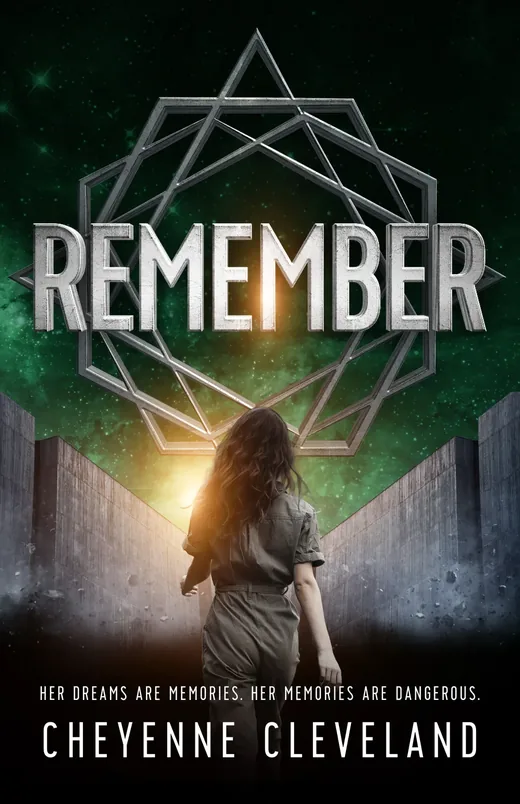
REMEMBER
Her dreams are memories. Her memories are dangerous.
CHEYENNE CLEVELAND
Copyright
This is a work of fiction. Names, character, places, and incidents are either the product of the author’s imagination or used fictitiously. Any resemblance to actual persons, living or dead, businesses, companies, events, or locales is entirely coincidental.
Copyright © 2026 Cheyenne Cleveland
All rights reserved.
Cover by Maria Spada
ISBN 979-8-9936886-0-2 (print)
ISBN 979-8-9936886-1-9 (eBook)
No part of this book may be reproduced in any form or by any electronic or mechanical means, including information storage and retrieval systems, without written permission from the author, except for the use of brief quotations in a book review.
Dedication
For my family,
I love you beyond the stars
“Remember me, O Lord, with the favor
You have toward Your people.
Oh, visit me with Your salvation,
That I may see the benefit of Your chosen ones,
That I may rejoice in the gladness of Your nation,
That I may glory with Your inheritance.”
Psalm 106:4-5
Chapter One
I remember the day Grandmommy died as if it were yesterday. It doesn’t help that I still see flashes of her frail body sprawled out on that dirty cot every time I close my eyes. My memory tortures me that way, replaying those last moments over and over again in my head: her messy gray hair plastered with sweat, her eyelids fluttering, tired and heavy, covering her hazel irises, her bony fingers cupped over her pale lips, failing to keep her insides from spewing out.
There are blood stains on the sheets, the same ones we used to catch her vomit.
It’s been almost ten years since she passed, but the foul stench of the soiled room still burns my nostrils whenever I think about it. It’s so potent I can almost taste it. My stomach turns in protest, but I don’t give in. Lucile sits in front of me during class, and she doesn’t handle contact with bodily fluids too well. I swallow to keep myself from spewing chunks. Although there wouldn’t be much running up my esophagus, anyway. My stomach contents consist only of bile and a few chewed-up crumbs from this morning’s breakfast: two stale nutritional crackers. They’re hard to swallow, even when I’m fortunate enough to get an entire bottle of water with my rations.
Professor Diaz dims the lights and flicks on the rusty projector, snapping my attention from the phantosmia, saving me from covering my bunkermate in barf and an unnecessary trip to Quarantine. Diagrams of filtration systems flash on the peeling paint of the lecture hall walls. At some point, he shifted from an overly opinionated world history lesson to a presentation on water purification, but I missed the transition while thinking about Grandmommy. I take advantage of the shadows and squeeze my eyes shut, tuning out his lesson and leaning into the memory.
“Reyna.” Grandmommy rasped my name through heavy breaths before vomiting again. Red mixed with yellow and green on her nightgown. She motioned for water, pointing with a shaky finger to a small cup on a metal stool beside the inexcusably soiled bed. She hacked bloody saliva into her hands and wheezed into another coughing fit. I held the cup to her mouth. Water droplets dripped from the rim, but there was barely enough liquid to wet her cracked lips.
She patted my hand and forced a weak smile, her red eyes still sparkling with kindness. Grandmommy twisted in the bed and pointed underneath the mattress. Excitement bubbled in my seven-year-old chest. She was always hiding treasures for me under there, like marbles or peppermints. Things she could easily trade for an extra shift at the washhouse with some of the other women who lived in the Northern Sector of the barracks.
I shoved my hand beneath the lumpy cot and reached for whatever she hid. The pitter-patter of my heart intensified as I groped to find my present. To my surprise, my fingers came in contact with something much larger than an old piece of candy. It felt like paper, like the soft edges of a book. I pulled the item from its hiding place. My eyes widened as I took in a beautiful leather-bound journal, with I love you beyond the stars inscribed on the cover.
“Grandmommy, I-I can’t ...” I tried to give the journal back. It was too special a gift, one that must have cost her a fortune.
Grandmommy’s lungs gurgled with fluid. Her bony fingers strained to push the journal back into my small hands.
“Promise me you’ll remember.” She tapped the inscribed words.
My eyes welled with tears. “I promise.”
“I love you beyond the stars” was her way of saying she loved me more than anything else in the world. But it was also her way of reminding me she’d do just about anything for me, even if it meant breaking the rules.
Looking at the stars wasn’t something most kids got to do while growing up on the Omega Compound. Lockdown began promptly at sundown, and lights were off by ten p.m., no matter the time of year. Grandmommy loved the stars, though, and determined that no one was going to keep her from seeing them, not even the Commander himself.
When I was just a toddler, Grandmommy sewed herself a pincushion with scraps from the seamstress station at the washhouse. She used that little bolster to keep the locks on the bunker door from engaging whenever she wanted to sneak out at night. We’d tiptoe into the quadrangle after dark, when the guards had all retired to their homes, and sprawled out under the midnight sky. Grandmommy “oohed” and “aahed” at the galaxies spinning overhead that painted their dark canvas with flecks of color and pinpricks of light. It didn’t take long for me to decide that I loved the stars, too. There’s just something about the mystery of the sky—how it stretches on for miles and miles, leading to other planets and places bigger than our home. It makes the worries of life seem a bit smaller and less significant. At least for a time.
“I’m not going to be here much longer, Reyna. I can feel it in my bones.” Grandmommy’s voice strained, her eyes brimming with tears. “My body’s tired and longs to go home. To live among the stars.” Her head sank onto the thin pillow.
I need you—the words formed on my quivering lips, but no sound came out.
“Every time you look to the sky, think of me. I’ll be out there somewhere, floating above the clouds.” She closed her eyes. Her yellowed teeth peeked out from behind her chapped lips, and she smiled like she was picturing somewhere magnificent in her mind’s eye. “It’s a beautiful place,” she whispered.
Her eyes blinked open and she turned to look at me. I broke into sobs as I clenched the journal and held it tightly to my chest.
“Don’t weep, my dear,” she croaked. “My love for you will never fade. It’s like a cord that tethers our hearts together. Even if you can’t see me or hear me, we’re still connected.” She reached for me with a shaky hand. “Anytime you feel lonely, just look to the stars. You’ll feel my love tugging at your heart from the other end of the cord.”
Salty tears spilled down my cheeks. I shut my eyes, hoping to hold them back, but not even a twenty-foot wall like the one towering around our complex could bar them behind my lids.
Grandmommy’s hand went limp and slid off my knee. Silence filled the room—no more labored breathing or gargled coughing. Her mouth hung open, and her eyes went dull.
She was gone.
That was the day I learned what it felt like for a person’s heart to break. Sharp pain penetrated my chest and squeezed my head. I screamed and cried until the nurses finally came to take my grandmother’s lifeless body away. The women, faceless in their hazmat suits, wrapped her in a much fresher sheet than the one she had used to catch her own vomit only moments before.
I balled my fists and swung my bony arms, begging them not to take her—not to take Grandmommy. But they operated like robots, completely immune to my cries.
“I’ll remember! I promise! I’ll remember!” The words scratched my throat as Grandmommy was carried out of our one-room bunker. “I love you beyond the stars,” I whispered, my final farewell as the metal door slammed shut, sealing me inside.
I try to forget what happens next, but my mind won’t let me. That’s what it’s like when you lose the only person you ever had the chance of loving. Your last moments together sear your mind like a government brand burnt into your skin. These memories are like that for me— vivid, like I’m reliving the past all over again.
Muffled voices spoke outside the door. Certain words surfaced in their sentences.
“… she’s contaminated … her assignment … Bunker 112 …”
Panic gripped my chest when I realized they were talking about me, trying to figure out what to do with me. It was against the rules to let minors live on their own. It didn’t matter that I learned how to fend for myself when Grandmommy was bedridden. As a seven-year-old orphan, I wouldn’t even be given the chance to state my case before the Commander. My fate was decided for me.
The bunker door squeaked open. I tucked Grandmommy’s journal inside my oversized uniform just before another gaggle of nurses barged in. The swarm swept me from my home, through the bustled courtyard, and down an unfamiliar hospital corridor. They stripped me of everything: clothes, possessions, hope. I craned my head and watched my old jumpsuit, and my brand-new journal, disappear in the opposite direction. My throat clenched. I wanted to scream, but the weight of loss muted me.
The team of nurses rushed me through the decontamination process, ushering me into a shower. Warm water misted my bare skin, followed by a shock of cold. Goose bumps prickled my arms and legs. My teeth chattered. But I didn’t care. All I could think about was Grandmommy and how I managed to lose her journal.
The nurses dressed me in a crisp cargo uniform and yanked my long brown hair into a braid. I was fitted with a new pair of shoes and handed a package of nutritional crackers to munch on. The dry wafers got stuck in my throat and made me gag. I don’t know why I bothered to eat them. Feeding my rumbling stomach was the furthest thing from my mind.
A nurse gave me a small tin cup filled with water. I took a sip, but flashes of Grandmommy’s cracked lips stopped me from swallowing. I spat the water right back out into the cup.
The siege of nurses subsided, leaving only one to escort me to the Medical Center’s front entrance. She was much younger than the rest, thin and scrawny with hair as black as the night sky. From the looks of her, she was probably just assigned a permanent position at the hospital after aging out of school. Her smile wasn’t hardened yet by years of working with the sick and dying.
Soldiers waited for me near the doors, but before we reached the entryway, my chaperone dragged me behind the lobby desk. She crouched, eyes shifting as she reached inside her uniform.
“I think this belongs to you,” the kind nurse whispered. A leather-bound journal winked from behind her white coat. I gasped with relief. She put a finger against her mask, hooked a pen on the journal’s binding, and tucked my treasured book inside my new jumpsuit. I should have said, “Thank you,” but I just stood there wordless, blinking away tears.
The nurse gave my hand a squeeze, then stood. Masked and expressionless, she led me to the foyer. Before I knew it, half a dozen soldiers surrounded me, their dark green uniforms striking against the bleached backdrop of the medical center. I recognized the stern posture of the woman at the front of their formation: the Warden.
The Warden was a woman with broad shoulders and a serious face. Her dark hair, uncapped and wound into a tight bun, sat at the nape of her neck. The smell of her boot polish stung my nostrils. With her chin held high, the Warden stared down the bridge of her nose, examining me with hollow eyes. I held her gaze as long as I could before redirecting my gaze to the floor.
The soldiers shoved me through the hospital doors and onto the gravel of the barracks’ quadrangle. I shielded my eyes from the setting sun, fiery red over the edge of the concrete wall.
I glanced beyond my entourage, intrigued by movement in the courtyard. Remnants from the morning ceremony scattered the ground: a pathetic display of paper confetti and cheap red ribbons. A banner adorned with the numbers “1-0-0” waved in the stale breeze.
“One hundred years of prison,” the guard beside me scoffed.
It just so happens that Grandmommy died on Remembrance Day—the same day we’re expected to celebrate human existence despite the Last War. That poorly painted sign was hung to commemorate one hundred years of survival at the Omega Compound, but if you ask most people in the Southern Sector, there’s nothing celebratory about living trapped behind concrete walls for an entire century, when most of us are just barely living, getting by on measly rations and hiding from acid rain. Besides, Remembrance Day only reminds me that Grandmommy’s gone, that she didn’t survive.
I take a break from my memories and remember where I am, sitting in the middle of the classroom, suffering through one of Professor Diaz’s presentations. His slideshow skips to a collage of water sources. The images look dated, like they were taken before the Last War. I can tell because there’s greenery in the scenes, and I’m pretty sure grass hasn’t existed in the last century.
I hear a yawn from the boy behind me—Walter Cane, the Commander’s son. His feet kick my chair when he stretches his legs, and I have to grit my teeth to keep myself from saying something stupid.
Walter was there in the courtyard ten years ago on the day Grandmommy died. The thought of it thrusts me back into the scene, and once again I’m reliving my own Remembrance Day. I can still see the Commander standing with his family beneath that banner with the poorly painted numbers.
Commander Cane stood dressed in his freshly pressed suit. He shook hands with a man sporting a dark blue jumper and a matching beret. Even at a distance, I recognized the dispatch rider’s uniform. His stiff cap set him apart from the barracks guards. An air shipment had arrived. My stomach growled at the thought of food. The sight of his blue cap promised a morning meal, a shred of hope, but Grandmommy hadn’t lived to see it.
A cluster of men wheeled tall wooden crates through the quadrangle as the dispatch rider held out a clipboard to the Commander. Commander Cane scrawled a signature, then looped his wife’s arm through his. Mrs. Cane was a beautifully figured woman with an appalling fashion sense. Her ruby-red cheeks clashed with the bright purple dress that ruffled loosely to the ground.
My lips curled in disgust, and my face flushed with anger. Grandmommy died on a dirty sheet, and this woman had the gall to paint her face and trip over a garment worth enough to feed the whole compound.
Beside the portentous couple, a boy around my age kicked at loose gravel. With an exaggerated punt, a wayward cloud of dust coated Mrs. Cane’s dress. The Commander scolded his son. Taking hold of his arm, he dragged Walter further into the Northern Sector. His embarrassed wife brushed her fabric clean, then followed suit, escorted by a team of guards.
Witnessing the dysfunctional interactions between the Commander and his family only intensified the sting of my loss. It wasn’t fair. Walter Cane had his parents. He had clean clothes. He had food. He had a warm, clean bed. I sniffled and clenched my seven-year-old heart, holding back sobs.
Boots stomped the dirt in a rigid march, pushing me forward, kicking dust into my lungs. I coughed, unnoticed, and kept walking, silently counting my footsteps to keep the grief at bay.
Since Grandmommy and I occupied a bunker in the Southern Section, I was only vaguely familiar with the paths on the northern end of the barracks. Soon, a familiar structure came into view. I recognized the large rectangular building as the Mess Hall at the center of the compound. The tunnels connecting it to the Education Center made it easily identifiable. From there, the guards led me into the familiar southern side of the complex. My shoulders relaxed a bit with the feeling of home, but it was short-lived. Another wave of sorrow hit me when the guards pushed past my old bunker and crossed into the unfamiliar Forgotten Zone. We walked by several scattered bunkers until we came to the very edge of the barracks.
Shadow bathed the ground in gray, and I ventured a glance skyward. Above the caps of the soldiers, towering walls of concrete stretched into starless black. I tried to feel Grandmommy’s love tugging on my heart, but all I could feel was a heavy tightness burning in my chest. I shrank. Without her at my side, the confines of the walls seemed infinitely more constrictive.
The soldiers parted, revealing a small concrete shelter with a metal hatch door. The numbers “1-1-2,” painted in red, glared at me from the entrance. This was my new home: Bunker 112.
The Warden opened the door, and stale, warm air puffed into my face. The musty smell mimicked the scent of my family’s bunker across the compound, but the similarity didn’t bring me comfort. This wasn’t my real home, and it never would be. I held my breath.
The Warden saluted and dismissed the soldiers. When they disappeared and their footsteps faded, the Warden’s shoulders drooped. She relaxed onto one knee and addressed me, face to face.
“Sage.” The Warden called me by my surname, my dead father’s name. “This world wasn’t made for the weak. Only survivors,” she cautioned sternly. “You have to be strong now. You have to survive.”
The Warden spoke stiffly, as if I were older, forgetting that I was only a child who had just lost her grandmother. I balled my fists, sniffled, and, trying desperately not to cry, locked eyes with the heartless woman. But I couldn’t hold it in. I released my grip and sobbed. The Warden stood and, with a heavy hand on my shoulder, nudged me through the door.
I was crying so hard I could barely see. I squinted through my tears and surveyed the room with blurry vision. A single bulb swinging from the ceiling provided enough light to bring my surroundings into focus.
In the far right corner of the room, a mirror hung over a full metal wash sink. A knee-high concrete block sat to its side. I spotted the hole on top and knew right away that that’s where I was expected to do my business.
I counted six cots in the bunker: two on the right wall, two on the left wall, and two stacked at the back of the room. That’s when I first laid eyes on Erika. The stocky girl sat on the edge of the bed furthest to the left. Her unwelcoming, furrowed brow peeked through the middle part of her brunette hair. I averted my gaze and forced down my remaining sobs. She seemed to disapprove of them, and I didn’t want to make matters worse by blubbering over my dead grandmother.
Another girl with a tiny frame, bright blonde hair, and a scarred face hung from the ladder attached to the bunk beds in the back. She released her grip on the ladder to wave at me, but lost her balance. She teetered for a moment, but managed to right herself before falling. A third girl with tight black curls snored on the cot closest to the door. Her glasses fogged on every exhale. Only the three occupied cots were made up with sheets and a blanket. The other three mattresses remained bare.
“Make yourself comfortable, Sage.” The Warden plopped bedding into my arms and nodded toward the naked cots.
“Lights off within the hour. Try to get some sleep.” The Warden stalked out of the bunker, leaving all four of us completely unsupervised.
That’s when I learned that some rules don’t apply in the Forgotten Zone.
I stared at the hard metal hatch until the gears of the door clicked into place, locking us in for the night. Spinning slowly, I surveyed the empty beds. Erika scowled, warning me not to get too close, so I avoided the left side of the room.
“Hey.” The small blonde girl waved me toward the back. “You can share the bunk with me.” She climbed down the ladder, took the bedding from my hands, and, without waiting for an answer, began fixing the linens on the bottom bunk.
“I’m Gertrude,” she said, “but you can call me Geri.” Gertrude grinned, proudly showing off her missing front teeth. She pulled the fitted sheet taut against the mattress. “What’s your name?”
“Reyna.” My voice cracked as I spoke. “Reyna Sage.”
“Reyna,” Gertrude repeated while smoothing out the starch blanket. “Reminds me of sun rays. I like that.”
Gertrude pushed the stray strands of hair away from her face, giving me a better view of the rippled scar across her cheek. It looked like melted plastic, like her face had been set on fire.
“I think that’s what I’ll call you.” Gertrude smiled contentedly. “Rey.”
I forced a smile, then flicked my eyes to the girl on the left side of the room, wondering if she had noticed.
Gertrude giggled. “That’s Erika. You’ll get used to her.” Her voice dropped to a whisper. “She’s actually pretty nice.” She winked and flashed another toothless smile before shimmying up the ladder, disappearing from sight. “Welcome to Bunker 112. I think you’ll like it here.”
Despite my new friend’s hospitality, that was the loneliest night of my life. I missed the warm touch of Grandmommy’s brittle hands, the soothing sounds of her lullabies, the subtle sweetness of her scent—soap flakes and sweat, the lingering aroma of a long day’s work at the washhouse.
The single bulb extinguished, and the room went dark. I fumbled onto the squeaky bed and pulled the blankets up to my neck. Clutching the journal in my hands, I sniveled myself to sleep.
Blackness overtook my vision, erasing images of the worst day of my life, but my heart still longed for Grandmommy. I could feel it groping in the dark, trying desperately to find the edge of her cord, the one she said would keep us connected even after she was gone.
And that’s when it happened.
A spark seared the void of my slumber. Vibrant colors banished sleep’s habitual darkness. I dreamt—actually dreamt—of a meadow blanketed in radiant, purple flowers. The cone-shaped petals whistled a lilting tune, and the wind’s dance conducted the choir. Their harmonies filled my ears and poured out of my mouth as I sang along. I didn’t need to be taught their song. It came to me instinctually, as if I’d been singing it my whole life.
Laughter joined the choir from beyond the meadow. The chortle belonged to a figure running toward me: a stunning woman with radiant skin and floating, translucent hair. Light refracted from her in every direction as she emanated health and beauty.
“Meet me here,” the voice soothed, reverberating around me.
My jaw dropped. I knew that voice. It was Grandmommy. She looked nothing like she did when she died. She was youthful. Her teeth were dazzling white and her cheeks were plump, but it was undoubtedly her. The same kindness shone from her now-iridescent eyes, no longer muddied in color, but clear and glowing. She was happy, and she was free.
When I woke up, the bunker was dark, and soft snores filled the room. I hugged the journal to my chest and snatched the pen from its spine. Through the hours that followed, I scribbled out every detail I could remember about that dream. This was the place Grandmommy talked about—the place beyond the stars.
Geri forces a handkerchief into my hands. The gesture snaps me from my memories.
“Here,” she whispers.
I dab my eyes in the dim light of the classroom, thankful for the soft cloth against my cheeks. I lost my handkerchief while working at the washhouse last week. It must have fallen out of my pocket and into a pile of dirty clothes when I wasn’t looking. I’ve tried using scraps of material to wipe sweat, tears, and snot from my face, but the itchy fabric only seems to make things worse.
Professor Diaz switches the projector slide. An illustration of molecules pulses on the wall. I wad the handkerchief and give it back to Geri.
“Keep it,” she insists. “You need it more than I do.”
She’s probably right.
For the last ten years, Geri’s been my greatest ally and confidant. I never have to explain myself to her, elaborate on why some days are harder than others. She just gets me. And she’s the only one who knows about my dreams.
Some nights, I still see blackness, like everyone else. I didn’t even know I was different until I started talking to Geri about what I saw while asleep. She looked at me and crossed her eyes like I had two heads growing out of my neck. We started asking around discreetly, trying to discover if anyone else saw things in the night. As it turns out, I’m the only one.
It’s a shame, though, because dreaming makes living a little bit easier. It’s a chance to experience a world much different than the one I see while I’m awake. Most days I can’t wait to go to sleep, hoping for another chance to witness Grandmommy spinning and laughing the way she always wanted to when she was ill and alive.
I swipe a fresh tear from my cheek as Professor Diaz flips the lights on in the lecture hall, officially forcing me back into reality. I slide down into my chair as I try to go unnoticed. The clock above the doorway steadily ticks; only ten more minutes left before we’re dismissed for lunch.
I lick the salty film from my lips, and my stomach growls on cue. The only thing better than not getting called on in class would be an edible meal. And the only thing better than that would be to visit my dream world tonight. Unfortunately, none of those things are guaranteed.
[END OF EXCERPT]
I HOPE YOU ENJOYED THIS EXCERPT!
If you did, here are a few ways you can help support this story!
- Share with friends or on social media! As a reader, your opinion of a book holds a lot of weight. Word of mouth is a type of marketing that authors can only dream of, because YOU have all the control. A friend’s recommendation means far more than any social media post of blog. So if you want to help this book make waves and reach more readers, please do tell your friends!
- Add it to your Goodreads TBR – this lets your friends on Goodreads know about the story and your excitement about it.
- Tell your library! Request that this title be available to read at your local library so other readers in your area can enjoy this story too!
If you’ve made it this far, THANK YOU for your support and enthusiasm. It makes what I do as an indie author possible.
I can’t wait for you to read the rest of REMEMBER!
Cheyenne
Continue Reyna’s story
Buy Remember and continue Reyna’s story.
The complete book is available now. Choose your preferred retailer, join Cheyenne’s reader list, or follow her official pages.
Buy Remember now
Available now in paperback and eBook formats.
Join the reader list
Receive book news and updates directly from Cheyenne.
Follow Cheyenne
Find Cheyenne Cleveland’s official social and author pages.
“This is one of those dystopian books that stick with you forever.”Fiction By Faith · Goodreads / ARC
“Wonderful cinematic writing, world-building, and characters with real depth.”Vikki Sorensen · Goodreads / ARC
“A haunting dystopian novel and a must read for fans of the genre.”LDT · Amazon
Copyright © 2026 Cheyenne Cleveland. All rights reserved. Cover by Maria Spada.
Preview website by authors.kronatrix. Website strategy by KRONATRIX.